
What comes first: employee well-being or employee engagement?

“Engagement levels are low. What should we do?”
If you’re in HR, this is a conversation you’ve had with your CEO, manager and team.
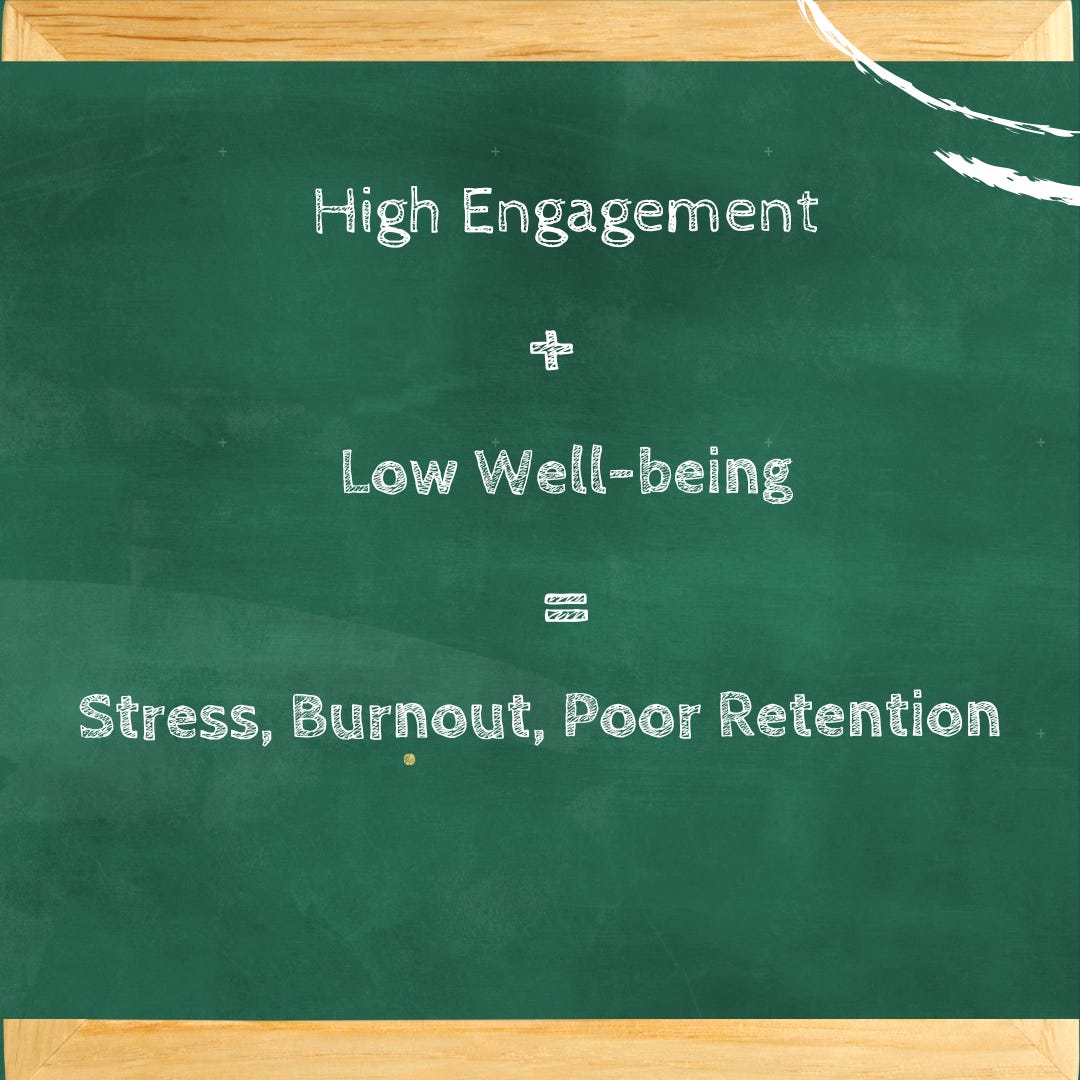
If your organization is in the same boat, use Gallup’s Five Elements of Well-being to steer the conversation differently. Because even if you increase engagement levels, it doesn’t mean your employees are doing well. Math hasn’t been my strongest skill, but here’s an equation I think we can all understand.
High employee engagement + Low employee well-being = Stress, Burnout and Poor retention
What are the five essential elements of well-being?
The essential elements of well-being are based on Gallup’s study that asked questions about relationships, jobs, communities, health and wealth in more than 150 countries. Their research provided insight into the well-being of 98% of the world’s population, and five categories emerged.
️Career Well-being (this element has the most substantial impact on overall well-being according to Gallup’s data)
️Social Well-being
️Financial Well-being
️Physical (and mental) Well-being
️Community Well-being
How to incorporate well-being into the employee engagement discussion
The next time engagement levels become a topic of conversation, ask, “How is our organization impacting and supporting the well-being of our employees?”. But if you want to be more specific about identifying root causes, here are questions you could ask when integrating employee well-being into employee engagement discussions.
️Career Well-being: Are our employees fulfilled and growing in their jobs? Do they like what they do every day?
️Social Well-being: Do our employees have meaningful relationships and support systems in their personal and professional lives?
️Financial Well-being: Do our employees have financial security and have access to develop their knowledge of money management practices?
️Physical (and mental) Well-being: Do our employees have enough energy and emotional capacity to accomplish what they need to do each day?
️ Community Well-being: Are our employees empowered to be engaged in their communities and feel connected to the environments where they spend their time?
After digging, surveying and speaking with your employees, here’s what you might discover:
Unclear career paths and lack of skills development in your organization have become hindrances to career well-being.
Your organization’s reach-for-the-stars targets affect your employees’ physical and mental well-being.
Having employees return to the office full-time without the intention to redesign in-person culture doesn’t enhance social well-being but instead pulls employees away from their community.
Align short-term incentives and long-term objectives
Gallup’s research determined that focusing on short-term incentives only detracts from your well-being. You can purchase a new phone every time Apple releases an iPhone, but the excitement of having the latest model in your back pocket dissipates when you lose sleep over your mounting debt. However, if you can identify short-term incentives consistent with your objectives, you will feel empowered to make the right decisions.
The notion of aligning short-term incentives with long-term objectives can be translated into workplace and employee engagement practices. For example, your organization could impact employees’ career well-being by investing in a quarterly mentorship program and one-on-one career coaching to support their skills development and improve their career decision-making. Your organization could positively impact employees’ financial well-being by inviting a financial planning expert to lead a workshop on money management at the start of the calendar year or before annual bonuses.
Caring about well-being is the human thing to do
It’s fair to say that workplaces aren’t and can’t be the only thing contributing to well-being. However, we can’t pretend that our work environments and the experiences that come along with them don’t play a significant role. And if you’re having trouble convincing someone of this, remind them there are 2,087 average work hours in a calendar year.
The modern workplace wants employees to bring their whole selves to work but has yet to make the necessary leaps to support the whole self we speak of. The level of responsibility that comes with that kind of request begins with broadening your understanding of employee well-being and its connection to employee engagement.
So, why do I recommend adding the five essential elements of well-being to your workload? It’s crucial that before you try to motivate employees with a new initiative, you take the time to identify which of your organization’s systems, policies and practices aren’t making their lives any easier. When it’s decision time, disengaged employees will eventually leave the organization on their own, but you don’t want the highly engaged ones to go because your organization ignored their well-being.
Workthrough is a career engagement consultancy at the intersection of employee experience and professional development. We help workplaces make career development a cornerstone of their talent management strategy. Want to chat? Get in touch at hello@workthrough.ca.